 Wisp OS
Shelf
A floating bar with a centered launcher button, pinned apps, and a status area.
A Codez Studios project
A lightweight Linux-based operating system designed for 4 GB devices, with a desktop experience built around a Wayland shell. Linux and Android app support are part of the vision.
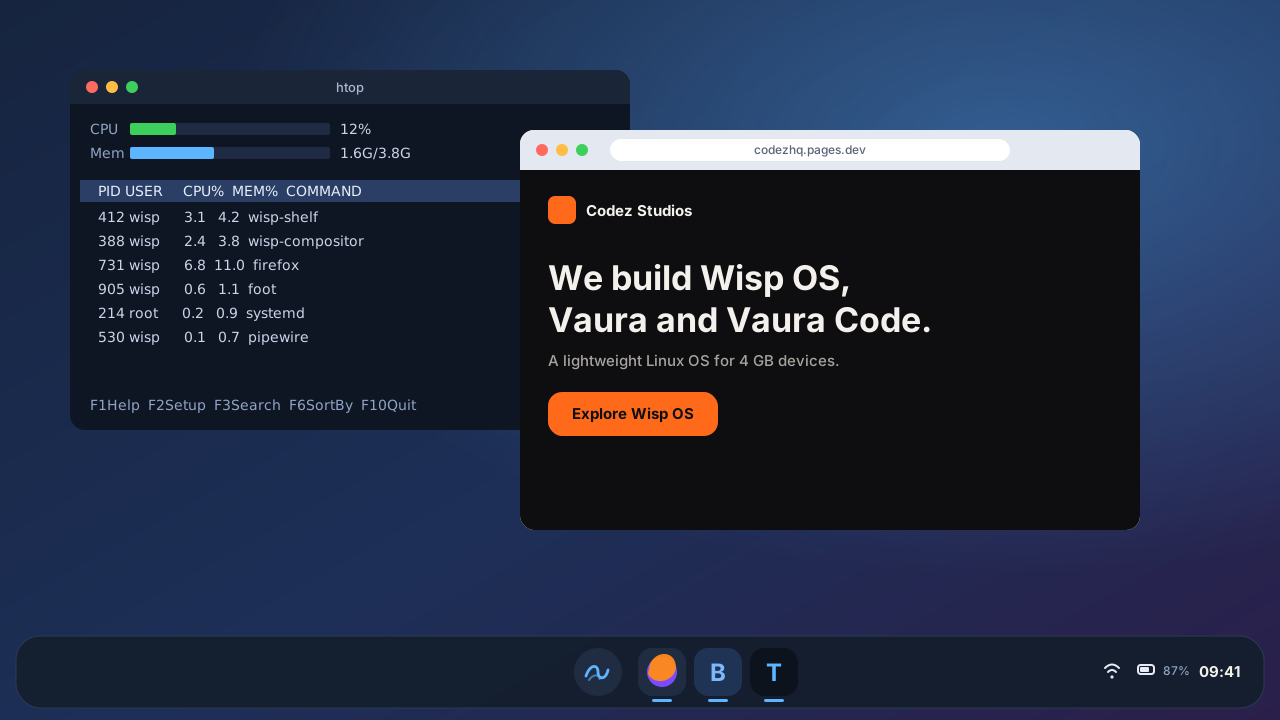
The Wisp desktop shell, wisp-shelf, runs on Wayland and is tested on every push.
A floating bar with a centered launcher button, pinned apps, and a status area.
An app grid with search for finding applications.
A tray for the settings you reach for most.
Switch between a dark and a light look without changing how the shell works.
Menus and the launcher move with spring-based motion, so they feel smooth rather than abrupt.
Written in C with cairo, so the shell stays small enough for 4 GB devices.
Three ideas guide every decision in the system.
Wisp aims to feel quick on the 4 GB laptops that bigger desktops struggle on, so every piece starts small.
The swirl logo sets the tone: rounded shapes, gentle motion, and type with curved letterforms.
The goal is to bring Linux and Android apps along, so the system is useful from day one.
Wisp OS is early. Here is what exists now and what comes next.
Wisp OS is a lightweight Linux-based operating system from Codez Studios, designed for 4 GB devices and built around a Wayland desktop shell.
Not yet. The bootable Wisp OS image has not started development. What exists so far is wisp-shelf, the desktop shell.
Many laptops ship with 4 GB of memory. Wisp is designed to keep those machines feeling quick, with a small shell written in C.
Linux and Android app support are part of the vision for Wisp OS, but they are not built yet.
Wisp OS is made by Codez Studios, an independent software studio.
Wisp is made by a small independent team and is still early. Follow Codez Studios on GitHub for updates, or say hello if you want to help.